Diabetic foot ulcers cause substantial illness, hospital use, and lower-limb amputation. In a 2017 review, Armstrong and colleagues estimated that between 19% and 34% of people with diabetes are likely to develop a foot ulcer in their lifetime. Ulcers often recur after healing, with about 40% of patients affected within one year and 65% within five years, according to the same review. NPWT for diabetic foot ulcers is available in many countries, but its benefit remains debated. This article reviews the randomised trial, systematic review, and guideline evidence. It then sets out the clinical conditions under which the evidence supports use.
What the randomised trials show
Two randomised trials provide most of the direct evidence for NPWT in diabetic foot wounds. Both report faster or greater healing with NPWT. Each is a single study, so the findings need careful interpretation.
Surgical wounds after partial foot amputation
The Diabetic Foot Study Consortium randomised 162 patients with partial foot amputation wounds across 18 centres over 16 weeks, as reported by Armstrong and colleagues in 2005. Eligible wounds extended up to the transmetatarsal level, and patients needed adequate perfusion. Time to complete closure was faster with NPWT (P = 0.005). Adverse events were similar between groups, and wound infection was the most common. The authors described fewer re-amputations as a possible benefit, not a demonstrated one.
Chronic diabetic foot ulcers
In a 2008 Diabetes Care trial, Blume and colleagues randomised 342 patients with diabetic foot ulcers to NPWT or advanced moist wound therapy, which mainly uses hydrogels and alginates. Complete closure meant full skin coverage without drainage or a dressing requirement. By day 112, 43.2% of NPWT-treated ulcers had closed, compared with 28.9% of moist-therapy ulcers (P = 0.007). The median time to closure with NPWT was 96 days (95% CI 75.0 to 114.0). Secondary amputations were fewer with NPWT (P = 0.035). Complications such as infection did not differ at six months. The absolute difference in closure was 14.3 percentage points, calculated from the reported counts.
A P value below 0.05 suggests that a result is unlikely under no true effect. It does not show that the difference matters to patients. Closure is a surrogate outcome. It stands in for results that matter more to patients, such as avoiding amputation or infection and maintaining function.
Systematic review evidence
A 2018 Cochrane review by Liu and colleagues pooled 11 randomised trials with 972 participants. Its authors rated most main outcomes as low-certainty evidence, and one as very low certainty. Low certainty means the true effect may differ substantially from the estimate.
Pooled results from the 2018 Cochrane review by Liu and colleagues:
Proportion of wounds healed, foot ulcers: 5 pooled studies (486 participants). RR 1.40 (95% CI 1.14 to 1.72). Certainty: low.
Time to healing, foot ulcers: 1 study (341 participants). HR 1.82 (95% CI 1.27 to 2.60). Certainty: low.
Amputation, foot ulcers: 3 studies (441 participants). RR 0.33 (95% CI 0.15 to 0.70). Certainty: low.
Proportion of wounds healed, post-surgical wounds: 1 study (162 participants). RR 1.44 (95% CI 1.03 to 2.01). Certainty: low.
Time to healing, post-surgical wounds: 1 study (162 participants). HR 1.91 (95% CI 1.21 to 2.99). Certainty: low.
Amputation, post-surgical wounds: 2 studies (292 participants). RR 0.38 (95% CI 0.14 to 1.02). Certainty: very low.
Pooled estimates from the 2018 Cochrane review by Liu and colleagues. RR, risk ratio. HR, hazard ratio, calculated by the review authors for time-to-healing outcomes. CI, confidence interval.
For foot ulcers, the pooled RR of 1.40 indicates a 40% higher proportion of healed wounds with NPWT than with dressings, according to the 2018 Cochrane review. A relative risk compares proportions, so the absolute benefit depends on baseline healing rates. The amputation estimates come from three studies and point towards fewer amputations, but the certainty is low. The authors could not determine whether 75 mmHg and 125 mmHg differ. Only one study of 40 participants compared them, over four weeks. The review found no evidence on quality of life or cost-effectiveness.
Guideline positions
The International Working Group on the Diabetic Foot (IWGDF) updated its wound-healing guideline in 2023. Its recommendations depend on wound type:
- Post-surgical foot wounds: consider NPWT as an adjunct to standard care. This is a conditional recommendation based on low-certainty evidence.
- Non-surgical diabetic foot ulcers: do not use NPWT as an adjunct to standard care. This is a strong recommendation based on low-certainty evidence.
The guideline states that NPWT may reduce time to healing after surgery. It found insufficient evidence that NPWT shortens healing time in chronic ulcers. All recommendations apply when best standard care alone has failed to heal the ulcer. Best standard care includes sharp debridement (removal of dead tissue with instruments), offloading, revascularisation (restoring blood flow) where indicated, and treatment of infection. The guideline also notes that NPWT may require moderate to high costs, which may reduce equity where access is limited.
Limitations and conflicting evidence
Several limitations affect how far these findings can be applied.
- Small and short trials. The Cochrane trials enrolled 15 to 341 participants and followed patients for 4 to 16 weeks.
- Risk of bias. The 2023 IWGDF guideline judged all NPWT studies to be at moderate or high risk of bias.
- Industry funding. Two included trials were funded by an NPWT manufacturer.
- Limited applicability to poorly perfused wounds. The surgical trial by Armstrong and colleagues required adequate perfusion. The 2023 IWGDF guideline found insufficient evidence for chronic ulcers.
- Few patient-important outcomes. The 2023 IWGDF guideline identified no studies reporting mortality. The 2018 Cochrane review found no evidence on quality of life or cost-effectiveness.
Conflicting findings on amputation
The 2018 Cochrane review suggests fewer amputations with NPWT in foot ulcers. The 2023 IWGDF guideline found no difference in amputation in the studies with the lowest risk of bias, although those studies were relatively short. The conflict is unresolved, and the certainty of evidence is low on both sides.
Statistical significance is not the same as clinical importance. Healing is a useful outcome, but it differs from outcomes that matter most to patients, such as amputation, infection, and quality of life. The 2023 IWGDF guideline calls for better trials, including those with health-economic analysis.
Clinical application
NPWT is supported in defined post-surgical situations. It is not a routine treatment for every diabetic foot ulcer.
When NPWT may be considered
- Post-surgical diabetic foot wounds, such as wounds after partial foot amputation or surgical debridement, as supported by the 2023 IWGDF guideline and the 2005 Lancet trial by Armstrong and colleagues.
- Wounds that have not healed with best standard care, where trained staff and resources are available, as described in the 2023 IWGDF guideline and the 2024 EWMA update.
When NPWT should not be used
Most of the contraindications below come from the 2013 International Wound Journal review. Other sources are named where they apply.
- Non-surgical diabetic foot ulcers, as an add-on to standard care, according to the 2023 IWGDF guideline.
- Untreated osteomyelitis or malignancy in the wound.
- Exposed blood vessels, anastomotic sites, organs, or nerves, where the foam must not contact them directly.
- Non-enteric or unexplored fistulas.
- Necrotic tissue with eschar, until debridement is complete.
- Sensitivity to silver, for silver-containing foams.
- Wounds with inadequate perfusion, because the supporting surgical trial by Armstrong and colleagues required adequate perfusion.
Practical requirements
Before starting NPWT:
- Complete sharp debridement and treat infection first, following the 2023 IWGDF guideline.
- Confirm adequate perfusion, and offload pressure from the wound, as described in the 2005 Lancet trial by Armstrong and colleagues and the 2023 IWGDF guideline.
- Confirm that trained staff can set up the device, change dressings, and troubleshoot alarms, as described in the 2024 EWMA update.
During therapy, according to the 2024 EWMA update:
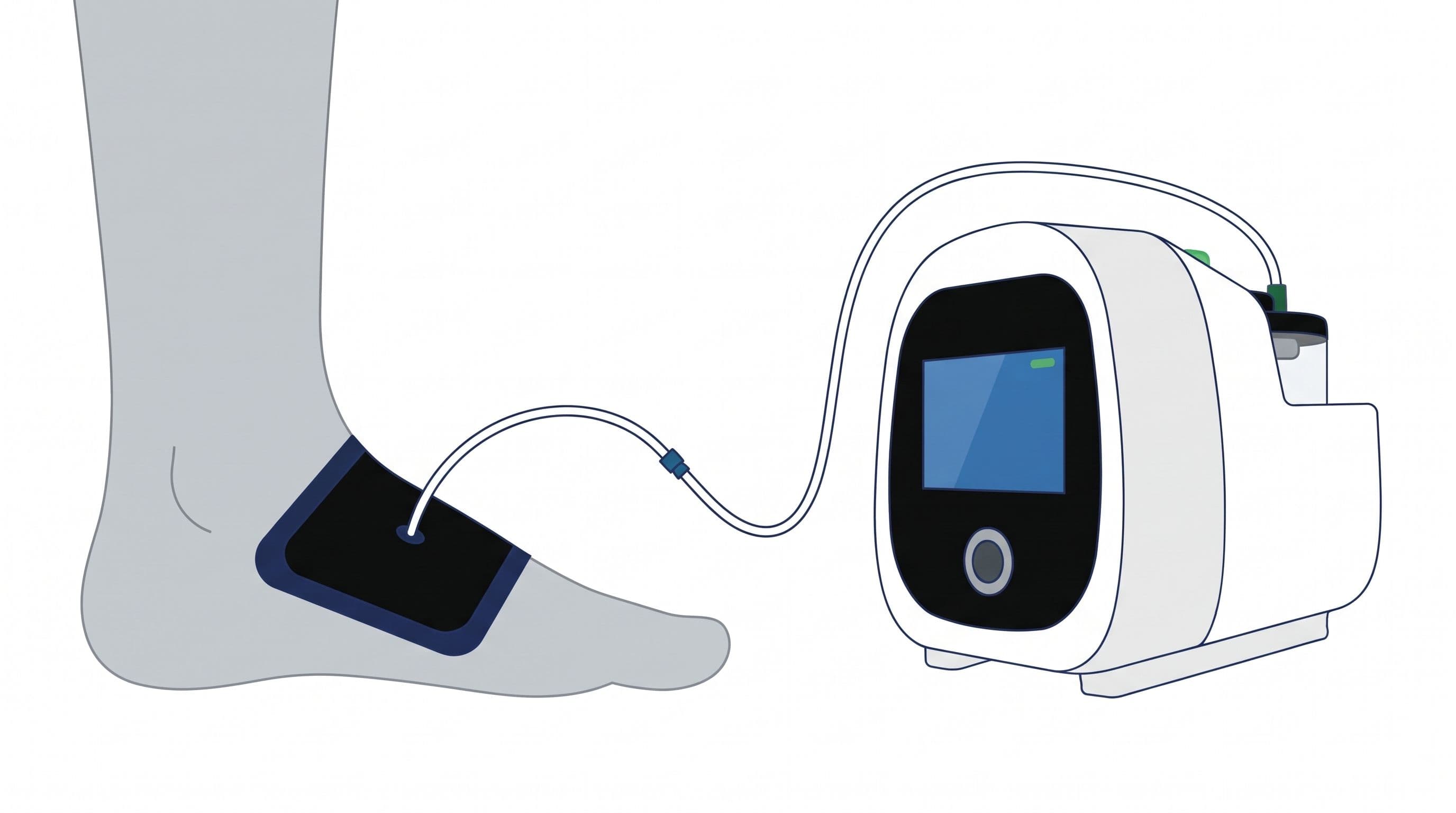
- Apply negative pressure, usually between 75 and 125 mmHg (millimetres of mercury).
- Change dressings about every two to three days.
- Respond to alarms and device faults promptly.
For home care:
- Provide patient and caregiver education, clear discharge routines, and remote monitoring where available, according to the 2024 EWMA update.
Training should begin before NPWT starts and continue over time, according to the 2024 EWMA update.
VACUHEAL position
The evidence supports NPWT in defined situations, most clearly after foot surgery. It does not support routine use for every ulcer. The guideline positions and trial populations point to the same practical conditions: careful wound selection, perfusion and infection managed first, and trained staff. This is why protocol and support matter. VACUHEAL's Scientific Office provides clinical support and training for hospital and home-care teams.
Frequently asked questions
Does NPWT heal diabetic foot ulcers?
NPWT may increase the proportion of diabetic foot ulcers that heal, but the certainty of evidence is low, according to the 2018 Cochrane review. Guideline support is limited to post-surgical foot wounds, where healing time may be reduced, according to the 2023 IWGDF guideline. Guidelines advise against NPWT as an add-on for non-surgical ulcers.
Is NPWT recommended after foot surgery?
The 2023 IWGDF guideline gives a conditional recommendation to consider NPWT as an adjunct to standard care for post-surgical diabetic foot wounds. The recommendation rests on low-certainty evidence and applies when standard care alone has not healed the wound.
Does NPWT reduce amputation?
The evidence is uncertain. A pooled analysis of three studies, reported in the 2018 Cochrane review, suggested lower amputation risk, but the certainty is low. The 2023 IWGDF guideline found no amputation difference in the studies with the lowest risk of bias, which were relatively short.
What pressure is used?
Usual settings are 75 to 125 mmHg, with exceptions up to 200 mmHg in selected cases, according to the 2024 EWMA update. The 2018 Cochrane review could not determine whether 75 and 125 mmHg differ, because only one 40-participant study compared them.
Clinicians who want to discuss case selection, protocols, or the evidence in this review are invited to contact the VACUHEAL Scientific Office. Scientific discussion and clinical support are available for hospital and home-care teams.
References
- Liu Z, Dumville JC, Hinchliffe RJ, Cullum N, Game F, Stubbs N, Sweeting M, Peinemann F. Negative pressure wound therapy for treating foot wounds in people with diabetes mellitus. Cochrane Database of Systematic Reviews. 2018;(10):CD010318. doi:10.1002/14651858.CD010318.pub3. Cochrane record
- Armstrong DG, Boulton AJM, Bus SA. Diabetic foot ulcers and their recurrence. New England Journal of Medicine. 2017;376(24):2367–2375. doi:10.1056/NEJMra1615439
- Armstrong DG, Lavery LA; Diabetic Foot Study Consortium. Negative pressure wound therapy after partial diabetic foot amputation: a multicentre, randomised controlled trial. The Lancet. 2005;366(9498):1704–1710.
- Blume PA, Walters J, Payne W, Ayala J, Lantis J. Comparison of negative pressure wound therapy using vacuum-assisted closure with advanced moist wound therapy in the treatment of diabetic foot ulcers: a multicenter randomized controlled trial. Diabetes Care. 2008;31(4):631–636. doi:10.2337/dc07-2196
- Chen P, Campillo Vilorio N, Dhatariya K, et al. Guidelines on interventions to enhance healing of foot ulcers in people with diabetes (IWGDF 2023 update). Diabetes/Metabolism Research and Reviews. 2024;40(3):e3644. Epub 2023. PubMed record
- Apelqvist J, Fagerdahl A, Téot L, Willy C. Negative pressure wound therapy: an update for clinicians and outpatient care givers. EWMA Document. Journal of Wound Management. 2024;25(2 Suppl 1):S1–S56. doi:10.35279/jowm2024.25.02.sup01
- Negative pressure wound therapy: past, present and future. International Wound Journal. 2013;10(Suppl 1):15–19. doi:10.1111/iwj.12170. [Author list to be confirmed against the journal record before publication.]
Reference 7 is the 2013 International Wound Journal review named in the clinical application section.